http://www.flixya.com/blog/5106305/Springhill-Group-Biologists-warn-about-Asian-frogs-extinction
García-Moreno said that the loss of frog species could have knock-on effects not just on biodiversity and the food chain, but on human development. He pointed to research that has identified naturally occurring chemicals, such as skin secretions from frogs, that can be turned into medicine to treat human beings. ”Amphibians play a very important role in ecosystems – they are a conveyor of energy and nutrients from very small animals to larger animals,” he said. ”They are natural pest controllers too. Some have chemicals in their skins that can be useful to medical treatments, such as cancer and perhaps Aids. We must try to conserve these creatures.” Scientists could also learn more about the deadly chytrid disease from studying Asia, noted Mi-Sook Min, research professor at Seoul National University. Some indicators suggest the disease could even have come from the continent, as most cases to date have been found in other continents which may indicate a long history in Asia whereby amphibians have evolved to live with the disease. However, there are also indications in other research that the disease could have been existing in Latin America since the 1880s. Waldman emphasised: ”We just don’t know – in fact the Asian crisis [over the disease] may be even worse [than in other, better documented areas] but we just don’t have enough information. We are overwhelmed by our ignorance.”
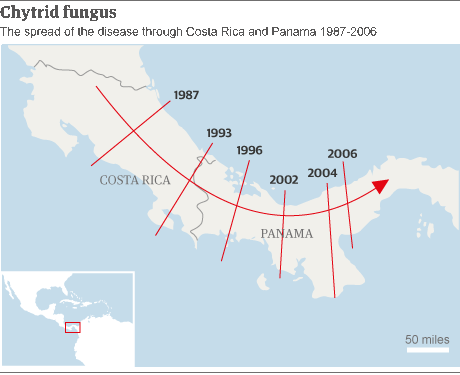
Map – spread of chytrid disease in Central America
Global trade, including the pet trade but also commerce more generally, has helped the fungus to spread widely. In some afflicted areas, frog populations plummeted by 95% in less than a decade. The fungus appears to disrupt fluid and electrolyte balance in frogs, depleting their sodium and potassium levels and causing cardiac arrest and death, according to research from the University of California, Berkeley, and the San Francisco State University.

No comments:
Post a Comment